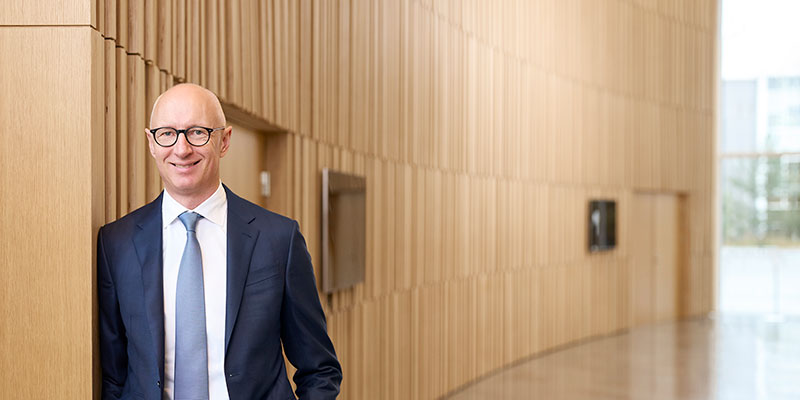
As Denmark prepares to take over the presidency of the EU, another president is stepping down. After two years as President of EFPIA (The European Federation of Pharmaceutical Industries and Associations), Lars Fruergaard Jørgensen, outgoing CEO of Novo Nordisk, will end his presidency in June 2025.
You took on the role of EFPIA President in June 2023. What did you see as the biggest challenges for the industry at that time?
LFJ: When I came on board, we were in the aftermath of the pandemic, and the EU’s position on access to medicines, R&D, and competitiveness was already changing. That’s why EFPIA formulated a common mission to work together for a healthier, stronger, and more competitive Europe. This has guided our work across a wide range of policy areas, including our revision of the EU pharmaceutical legislation, which became – and remains – the most important single issue for us.
The rules of the game for businesses have changed: geopolitical changes, accelerated technological development, green transition, and an aging workforce with chronic diseases
You mention pharmaceutical legislation – and you’ve been very vocal about maintaining the EU’s duration of Regulatory Data Protection, a form of intellectual property protection for pharmaceuticals. Why does this issue stand out for you?
LFJ: With increasing global competition, international companies will naturally place their investments in countries with strong, predictable IP rights, which are a prerequisite for our industry. As President of EFPIA, it has therefore been important for me to work for globally competitive and predictable legislation that promotes innovation. Innovation benefits patients in the form of new medicines, and at the same time, Europe relies heavily on innovation from, among others, the pharmaceutical industry, which is one of the major economic drivers. We do not yet know the outcome of the negotiations, but the European Parliament’s position is significantly different from the European Commission’s original proposal, and we are now seeing a broader recognition that EU legislation in this area too should support the strengthening of the EU’s competitiveness.
What has stood out the most for you in your time as President?
LFJ: Many complex challenges have stood out – dealing with the aftermath of COVID-19, working to improve the regulatory framework for our industry to strengthen EU competitiveness and not the opposite, and focusing on the need for a rapid environmental transition.
My role has been to spread the understanding that our sector is strategically important for Europe and to ensure that EFPIA’s voice was heard to ensure that our industry can continue to deliver life-saving medicines to patients around the world.
With the current global situation, it’s a different time now than when you took the role as President. What has that meant?
LFJ: It’s true that the global situation has changed since I became President. Just a few years ago, we faced the pandemic of the century, which we managed to tackle by collaborating closely with political decision-makers. Now, we are in a situation where the rules of the game for businesses have changed: geopolitical changes, accelerated technological development, green transition, and an aging workforce with chronic diseases. In this age, we must remain adaptable, maintain a close dialogue between industry and decision-makers, and focus on our core mission to develop and produce innovative medicines for patients.
The mission we started out with – to work together for a more competitive, healthier, and stronger Europe – is actually even more important today. This is because we represent an industry that is strategically important from an economic and employment perspective, but which can also provide solutions to some of the key challenges. Consequently, I will always advocate that we must insist on being a constructive partner to the societies in which we operate, and seek to take co-responsibility for finding solutions to societal challenges.
Industry and security policies have become bigger parts of EU health policy – how have you felt this at EFPIA?
LFJ: Ursula von der Leyen said it clearly when she presented her new Commission: “Our freedom and sovereignty depend more than ever on our economic strength. Our security depends on our ability to compete, innovate and produce.” It has become more widely recognized among policymakers that economic strength, security, and health are interrelated, and that the European innovative pharmaceutical industry and the wider life science sector form one of the major economic drivers.
What would you emphasize as the most crucial factor to make the EU more competitive?
LFJ: When we consider other regions, they have a strategic approach to supporting and promoting innovative industries. There is a need for initiatives that create an ecosystem to foster innovation,linking patients, research, startups, and industry. The Commission’s initiative to create a European life science strategy is an example of what is needed. The Danish life science strategy and the collaboration around it show the potential when public and private actors collaborate and consider the entire ecosystem. It is an example to follow.
If you could point to one thing, what would you like to see come out of the Danish presidency?
LFJ: If I were to point to one thing, I would like the Danish presidency to strengthen Europe’s competitiveness. Several times during my EFPIA presidency, I have pointed out the challenges we face in our industry, where Europe is lagging behind. For example, Europe’s share of global R&D investments has dropped by 25 percent over the past 20 years, and European life science businesses only have access to about 20 percent of the funding that their American counterparts have. Therefore, the announcement from the Danish government that competitiveness will be an overriding focus of the Danish EU presidency is very positive.